Can you attach a louvered pergola to a house?
A louvered pergola can be attached to a house when the wall and the connection suit it. Attaching one involves the house as much as the pergola. The wall carries part of the structure, the wall’s own rain protection is opened at each fixing, and the water from the roof needs a planned route away from doors and the foundation.
Louvano pergolas are built to order, and every Louvano wall-mounted layout is confirmed with [email protected] before an order. This article covers what decides whether a wall is suitable, how flashing works at the connection, where roof water goes, and when a freestanding layout is the better fit.
What decides whether a house wall can carry a pergola?
The structure behind the wall surface decides. Siding, stucco and brick veneer are decorative cladding. Decorative cladding is not a fixing point, so any connection has to reach the structure behind it.
That structure differs from house to house. Framing, its spacing and its condition vary with the age and construction of the home. A qualified structural professional assesses the wall construction and its condition, and then specifies the brackets, fixings and spacing for that particular wall.
Louvano pergolas use 304 stainless steel screws in the frame. The fixings that go into a house wall belong to the connection design for that wall. Installation details are confirmed against the product drawings and local codes.
How does flashing protect the wall at the connection?
Every fixing through a wall makes an opening in the layers that keep rain out of the house. Behind most siding sits a water-control layer, such as house wrap or building paper, that drains water down and out of the wall. Siding on its own does not provide that drainage path.
Flashing at the connection ties into the wall’s drainage layer, so water running down the wall is directed to the outside of the connection. The Building America Solution Center guide to flashing wall penetrations explains this principle with drawings.
The flashing shape and overlaps depend on the wall type and the connection design. The installer details the flashing before any siding is cut. After installation, the connection is part of the routine inspection of the pergola and the house wall.
Where does the rain go when a pergola is next to the house?
On a Louvano pergola, the double-wall aluminum louvers rotate from 0 to 120 degrees by remote control, and the motor is hidden in the frame. When the louvers are closed, rain runs from the louvers into the beam channels, down through the posts and out near the post bases.
Next to a house, the route the water takes after it leaves the frame matters. Doorways, walkways and the house foundation are close by. The drainage route for a specific layout is confirmed against the product drawings, and the ground around the posts is planned so water moves away from the house. The drainage article explains the full water path, and the foundation article covers the base under each post.
When is a freestanding layout the better fit?
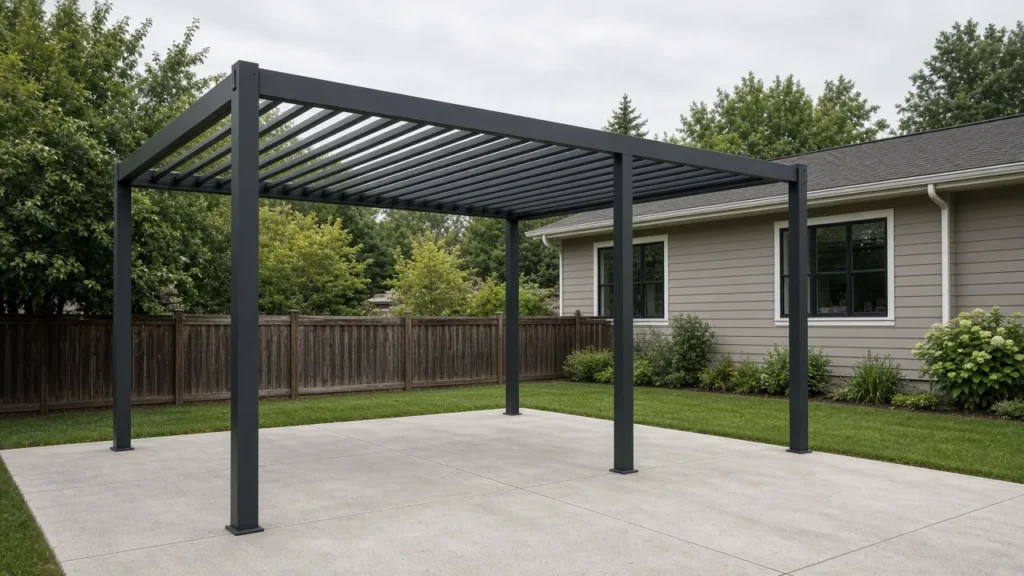
A freestanding pergola stands on its own posts and foundations and leaves the house wall untouched. It is the alternative when a wall is not suitable for a connection. Common reasons include a wall that is mostly glass, cladding or wall condition that makes fixing difficult, a roof overhang where the beam would sit, or a preference to keep the wall as it is.
A freestanding pergola close to the house leaves a gap between the pergola roof and the wall. Rain can fall through that gap, which matters when the pergola covers the path to a door. The freestanding vs wall-mounted guide compares the two layouts side by side.
Louvano sells three sizes: 3×3 m for $5,490, 3×4 m for $6,990 and 4×4 m for $8,990. Freight, tax, unloading, installation and custom engineering are quoted separately. Each pergola is powder-coated and built to order.
Does attaching a pergola change the permit picture?
It can. Local rules can treat a structure attached to the house differently from a freestanding one, and electrical work for the motor has its own requirements. The building department for the address sets which drawings, approvals and inspections apply. Homes under a homeowners association usually go through a separate design review as well.
The permit guide, the HOA approval article and the electrical requirements article cover each of these steps.
How is a wall-mounted Louvano layout confirmed?
Louvano wall-mounted layouts are confirmed with [email protected] before an order. That conversation usually covers the wall type, photos of the wall and the patio, the planned size, and any doors or windows near the pergola. After an order, questions go to [email protected].
FAQ
Can a louvered pergola be attached to any house wall?
No. Decorative cladding such as siding, stucco or brick veneer is not a fixing point. A qualified structural professional assesses the wall before a connection is chosen, and a freestanding layout is the alternative when the wall is not suitable.
Does attaching a pergola affect the wall’s rain protection?
Every fixing makes an opening in the wall. Flashing that ties into the wall’s drainage layer directs water to the outside of the connection, and the connection is part of routine inspection after installation.
Where does rain go on a pergola next to the house?
Rain runs from the louvers into the beam channels, down through the posts and out near the post bases. The drainage route for each layout is confirmed against the product drawings.
What does a freestanding layout change?
A freestanding pergola leaves the house wall untouched and stands on its own foundations. It has posts at every corner and leaves a gap between its roof and the house wall.
More answers are on our FAQ page.
Louvano motorized louvered pergolas are powder-coated, built to order and operated by remote control.